By Paul Zhang, MD, PhD
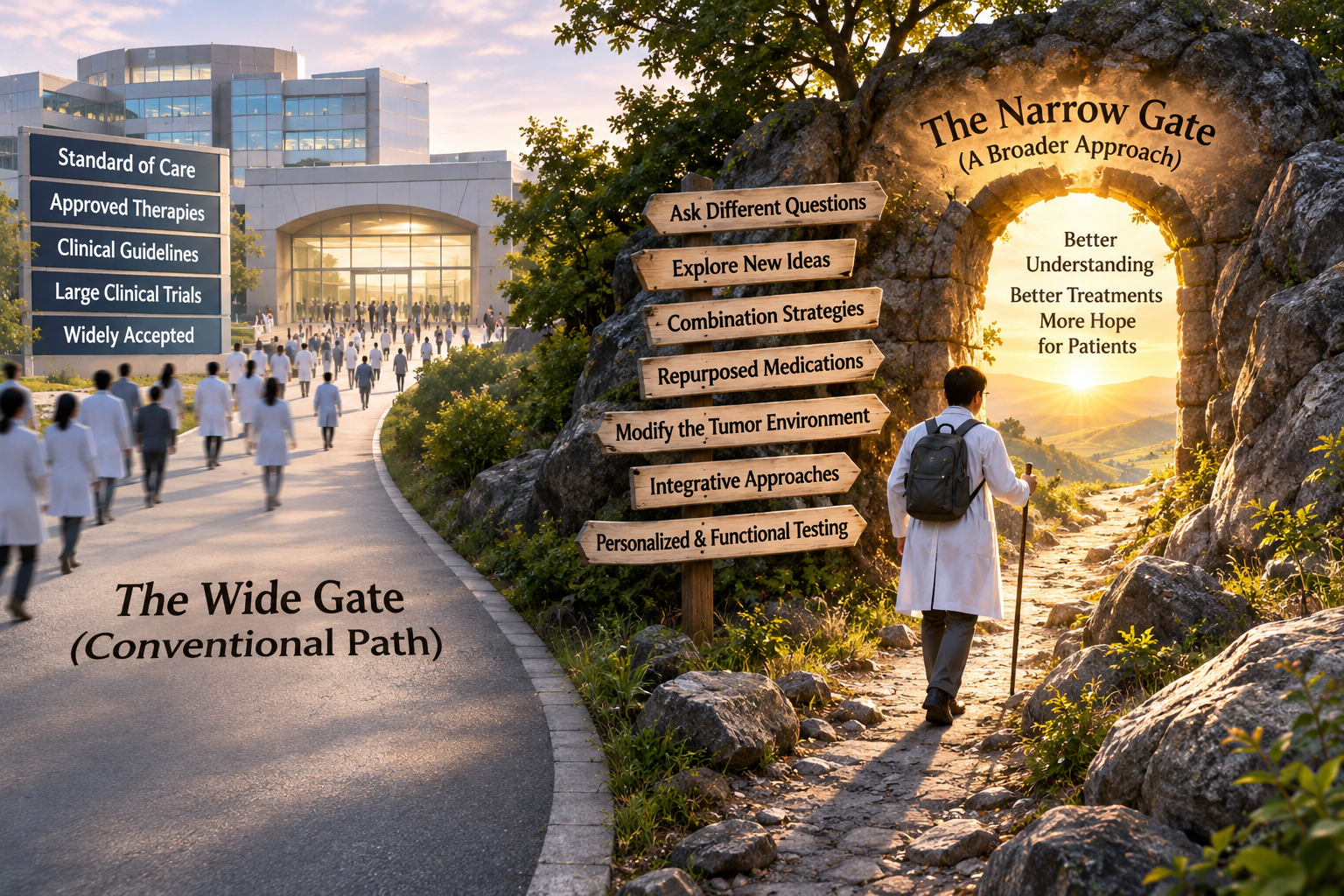
Enter through the narrow gate. For wide is the gate and broad is the road that leads to destruction, and many enter through it. But small is the gate and narrow the road that leads to life, and only a few find it.
Matthew 7:13–14 (NIV)
The narrow gate is a biblical metaphor for choosing a difficult path rather than following the easier road taken by the majority. Although the verse speaks primarily about spiritual life, its message has a special meaning for my journey as a cancer researcher and medical oncologist.
Throughout my career, I have often found myself questioning established ideas in cancer biology and treatment. Not because I believe conventional oncology is wrong, but because I believe it is incomplete.
Modern oncology has achieved remarkable progress. We have developed increasingly effective chemotherapy, targeted therapy, immunotherapy, and precision medicine. Yet cancer remains one of the most difficult diseases to cure, particularly when it becomes metastatic or resistant to treatment.
This raises a question that has guided much of my professional life: Are we looking at cancer from enough different perspectives?
My Journey Through Cancer Research
My scientific journey began with fundamental questions about why cancer cells survive treatments that should kill them.
At Moffitt Cancer Center, I studied cancer stem cells, oxygen biology, mitochondrial function, apoptosis, and mechanisms of drug resistance.
At that time, the cancer stem cell concept was far from widely accepted. The prevailing view focused largely on genetic mutations and the uncontrolled growth of cancer cells. The idea that a relatively small population of cancer cells might possess stem-like properties, sustain tumor growth, resist treatment, and contribute to recurrence challenged conventional thinking. Evidence was still limited, experimental models were imperfect, and many researchers questioned whether cancer stem cells represented a distinct and clinically meaningful population.
Pursuing this research was therefore a narrow gate. It was difficult to gain acceptance for ideas that did not fit the dominant scientific framework. Yet subsequent research has demonstrated the importance of stem-like states, cellular plasticity, and tumor heterogeneity in cancer progression and treatment resistance. Although many questions remain, I believe this was the right scientific direction, even when it was not a popular one.
Another unexpected research direction began with DMSO. An accidental laboratory observation led me to investigate its ability to induce apoptosis in cancer cells. What initially appeared to be an unusual observation became an important scientific question: Could changing the differentiation state of cancer cells also change their susceptibility to cell death?
At Memorial Sloan Kettering Cancer Center, I continued my research on cancer stem cells, particularly multiple myeloma stem cells, while also exploring the relationship between cellular differentiation and apoptosis, including the biological effects of DMSO and the differentiation agent Zolinda. This work contributed to research published in the Proceedings of the National Academy of Sciences (PNAS).
At that time, the cancer stem cell concept remained controversial, and the relationship between differentiation and apoptosis was not fully understood. Continuing this research meant pursuing questions that many scientists were reluctant to embrace. It was still a narrow gate.
At Baylor College of Medicine, my research focused on developing high-throughput drug screening methods using patient-derived tumorspheres, a model that can enrich for cancer cells with stem-like properties. Culturing cancer stem cells was technically challenging, and performing high-throughput screening of multiple drug combinations was even more difficult.
We also explored phytochemicals and repurposed medications, investigating whether combinations of agents could interfere with multiple cancer survival pathways rather than focusing exclusively on one molecular target.
This approach was not widely pursued, partly because of its technical complexity and the limited acceptance of cancer stem cell models. Once again, I found myself walking through a narrow gate, trying to develop new ways to identify effective drug combinations against cancer.
At Yale, I studied the aging of hematopoietic stem cells. At that time, our understanding of stem cell aging was still limited, and relatively few researchers were asking how aging changes stem cell function and contributes to disease. It was an important but less popular research direction. Once again, I chose the narrow gate, pursuing questions that I believed would become increasingly important as our understanding of aging and stem cell biology advanced.
Across these institutions, one lesson became increasingly clear: Cancer cells do not exist in isolation. Their behavior is influenced by metabolism, the immune system, surrounding tissues, and numerous interconnected signaling pathways.
These experiences taught me that cancer is not simply a collection of genetic mutations. It is a complex biological system capable of adapting to environmental stress and therapeutic pressure.
Learning From Forgotten and Unconventional Research
Throughout my career, I have also been fascinated by scientific ideas that were once promising but later abandoned, overlooked, or considered too unconventional.
One example is William Coley’s bacterial toxin therapy, developed more than a century ago. Coley treated cancer patients using complex bacterial preparations intended to stimulate the immune system. His work preceded our modern understanding of cancer immunotherapy.
Later research attempted to identify individual active components, including tumor necrosis factor (TNF), bacterial lipopolysaccharides, and immune-stimulating DNA sequences. I followed this history with particular interest, including the work of Dr. Lloyd Old on TNF and cancer immunology.
I also explored the possibility of revisiting Coley’s approach through modern immunological research. My collaboration with MBV involved plans for early-phase clinical trials, including work with investigators at Harvard and Baylor College of Medicine. Unfortunately, MBV eventually went bankrupt, and the research could not proceed as planned.
This experience illustrated another narrow gate: Even scientifically interesting ideas may fail to advance because of financial, organizational, or regulatory barriers rather than a definitive scientific answer.
Another example was vitamin C. I was interested in the early work of Dr. David Golde and others investigating vitamin C in leukemia and cancer biology. At a time when vitamin C was largely dismissed in conventional oncology, I continued to question whether its pharmacological effects, particularly at high intravenous concentrations, deserved further investigation.
Today, high-dose intravenous vitamin C remains an area of active research, although its clinical benefits in cancer treatment have not been definitively established.
I also investigated vitamin B17, or laetrile, despite its controversial history and lack of demonstrated clinical efficacy. One patient with pancreatic cancer who used this approach survived approximately two years. That observation was memorable, but I recognized that an individual patient’s survival could not establish treatment effectiveness. The experience reinforced the importance of distinguishing clinical observations from scientific proof.
My laboratory interests also included methylene blue, its effects on cellular biology, and its potential applications in experimental cancer research. Some of these questions remain part of my continuing research interests.
These experiences taught me that scientific ideas should neither be accepted simply because they are unconventional nor rejected simply because they fall outside prevailing practice.
Photopheresis and Plasmapheresis: Another Narrow Gate
My interest in modifying the biological environment of cancer also led me to investigate photopheresis and plasmapheresis.
I explored photopheresis and ultraviolet-based approaches, including research activities in China, with the goal of understanding how treatment of circulating blood cells might influence immune responses.
Later, I became interested in therapeutic plasma exchange as a potential method of modifying the circulating environment that supports cancer progression and treatment resistance.
However, translating this concept into clinical practice proved difficult. Hospitals were reluctant to permit plasmapheresis for cancer-related indications outside established uses. Eventually, I had to pursue the acquisition of our own equipment to continue exploring this approach.
Emerging research, including work from Mayo Clinic, has renewed scientific interest in the role of circulating factors and plasma exchange in cancer biology. Nevertheless, its clinical effectiveness as an adjunct to cancer treatment remains uncertain.
Once again, I found myself pursuing a narrow gate, not because I wanted to be different, but because I believed the scientific question deserved investigation.
The Two Faces of Cancer
I have come to view cancer through what I call a bifocal approach.
Through one lens, every patient’s cancer is unique. Its genetic mutations, molecular characteristics, treatment history, immune environment, and mechanisms of resistance may differ from those of another patient.
Through the other lens, cancers share important biological characteristics. Despite their differences, many cancers depend on common processes such as uncontrolled proliferation, altered metabolism, resistance to cell death, immune evasion, and interactions with the tumor microenvironment.
Precision oncology has made enormous progress through the first lens, identifying individual molecular abnormalities and developing therapies against them.
But I believe the second lens deserves equal attention.
If cancers share biological vulnerabilities, can we develop treatment strategies that target these common mechanisms while simultaneously addressing the unique characteristics of each patient’s disease?
This is the foundation of my approach to oncology.
Practicing Oncology Through the Narrow Gate
My clinical philosophy is different from conventional oncology, but not radically different.
I believe strongly in evidence-based standard-of-care treatment. Surgery, radiation, chemotherapy, targeted therapy, and immunotherapy remain the foundation of modern cancer care.
However, I also believe that standard treatment should not always represent the boundary of scientific thinking.
For selected patients, I explore medically appropriate variations of established treatments, including lower-dose chemotherapy designed to reduce toxicity and potentially influence the tumor microenvironment. I am also interested in whether lower-dose immunotherapy can produce meaningful immune responses with fewer adverse effects, although the optimal doses and clinical benefits require further investigation.
Another area of interest is the careful use of repurposed medications. Drugs originally developed for cardiovascular disease, diabetes, infections, or inflammatory conditions may influence biological pathways relevant to cancer. Laboratory and early clinical studies provide intriguing possibilities, but promising mechanisms do not automatically translate into proven clinical benefits.
I have also explored complementary approaches, including high-dose intravenous vitamin C, mistletoe, plasmapheresis, and hyperthermia. My interest is not in replacing established cancer treatment, but in investigating whether these interventions can improve treatment conditions, influence the tumor microenvironment, or enhance therapeutic responses. Their clinical evidence varies considerably, and many questions remain unanswered.
The goal is not to use more treatments simply because they are available. It is to understand cancer more completely and identify rational combinations that may offer patients additional opportunities.
In my daily practice of oncology, I continue to walk through the narrow gate. While standard-of-care treatment remains the foundation of my practice, I also explore additional approaches that go beyond conventional oncology. Some of these treatment strategies are not widely accepted by my colleagues and peers, particularly when clinical evidence is still emerging. Practicing oncology differently, even when the differences are not radical, can be challenging. Yet I believe that responsible innovation, careful clinical observation, and continued scientific investigation are essential to improving cancer treatment. For me, the narrow gate is no longer just a path in cancer research. It has become a lifelong commitment to questioning, learning, and searching for better ways to care for patients.
Why Is the Gate Narrow?
The narrow gate in cancer research is not necessarily the path of unconventional treatment. It is the path of asking difficult questions and accepting the responsibility to test the answers.
Modern clinical research understandably favors treatments that can be standardized, funded, and evaluated through large clinical trials. This system has produced extraordinary advances.
Yet it can be difficult to investigate complex combinations of inexpensive generic drugs, individualized treatment strategies, or interventions that lack strong commercial sponsorship.
A single new drug may attract substantial investment, while a combination of several older medications with potentially interesting biological effects may struggle to obtain funding.
I have experienced these challenges throughout my research career.
The history of combination chemotherapy offers an important lesson. Dr. Vincent DeVita and his colleagues helped establish combination chemotherapy through the MOPP regimen for Hodgkin lymphoma, demonstrating that combining drugs with different mechanisms could achieve results that individual agents could not.
I have reflected on this history, including discussions of MOPP and the early development of combination treatment. Yet today, developing complex combinations involving multiple drugs, especially inexpensive repurposed agents, remains extraordinarily difficult within existing clinical trial and regulatory structures.
Some of my ideas have produced encouraging findings. Others have failed, encountered technical barriers, or remained scientifically unresolved.
These experiences have taught me that questioning conventional wisdom is not enough. A different idea must still survive careful experimentation, critical evaluation, and ultimately meaningful clinical testing.
The narrow gate demands both intellectual independence and scientific humility.
The Future: Combining and Conquering
I believe the future of cancer treatment may depend increasingly on understanding how multiple biological mechanisms interact.
Rather than asking only which drug targets a particular mutation, we should also ask which combination of interventions can overcome the cancer’s capacity to adapt and survive.
This thinking has renewed my interest in functional drug sensitivity testing, patient-derived tumor models, circulating cancer cells, and laboratory systems capable of evaluating drug combinations against an individual patient’s cancer.
The long-term vision is to bring molecular precision and functional biological testing together, allowing treatment decisions to be informed not only by what a tumor’s genes predict, but also by how its cells actually respond.
This is an ambitious goal, and many scientific and practical obstacles remain.
But it is a direction worth exploring.
Choosing the Narrow Gate
After decades in cancer research and clinical practice, I have become convinced that progress requires both respect for established knowledge and the willingness to question its limitations.
I do not advocate abandoning conventional oncology. I advocate expanding it.
I do not believe every unconventional idea deserves acceptance. I believe every scientifically plausible idea deserves fair examination, with standards of evidence appropriate to its risks and claims.
And I do not believe that being different automatically means being right.
The narrow gate is not about rejecting the mainstream. It is about having the courage to pursue difficult questions, the discipline to recognize failure, and the humility to change direction when evidence demands it.
My career has taken me through laboratories, academic institutions, clinical trials, and the daily realities of caring for patients with cancer. Each experience has reinforced my belief that we must continue searching for better ways to understand and treat this disease.
The road may be narrow, uncertain, and sometimes lonely.
But for me, it remains a road worth taking.
Paul Zhang, MD, PhD
Omega Precision Oncology
Care, Share, Everywhere.